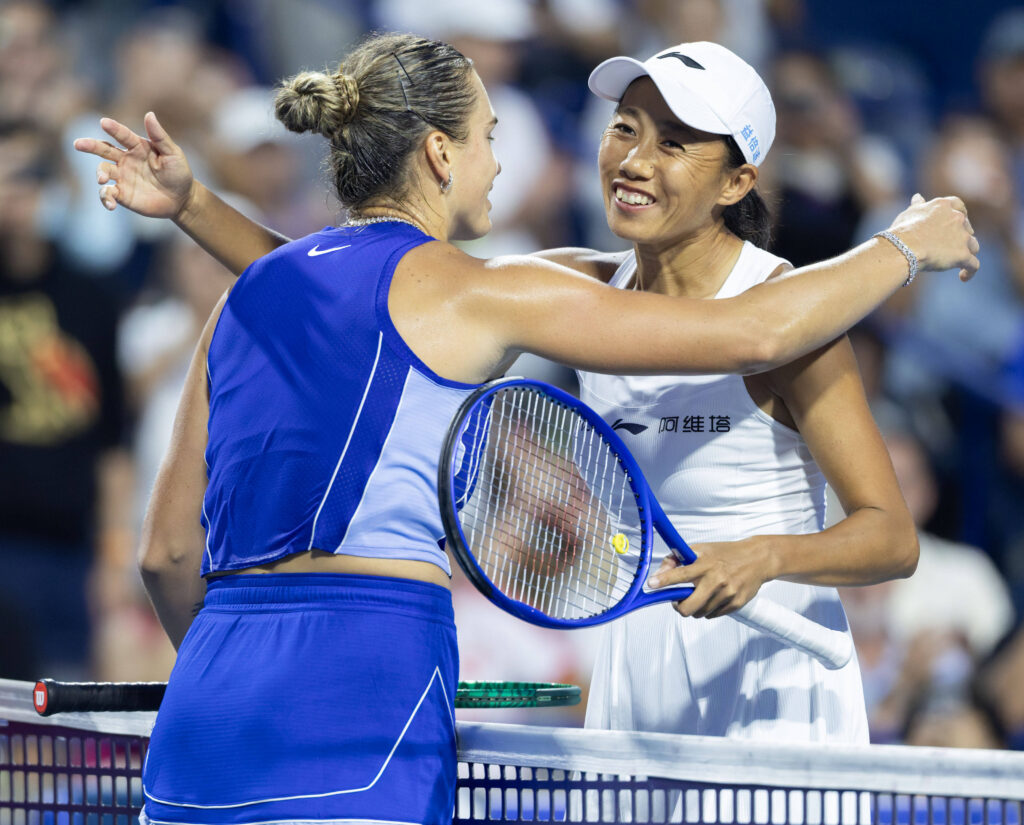
World No. 1 Aryna Sabalenka made an impressive start to her WTA Toronto 1000 campaign, defeating Shuai Zhang 6-3, 6-4 on Centre Court to book her place in the Round of 16. The top seed relied on powerful serving, aggressive baseline play, and composure under pressure to secure a straight-sets victory.
Sabalenka’s serve proved to be the foundation of her success. She fired five aces compared to Zhang’s one and won an outstanding 81% of points behind her first serve, comfortably surpassing Zhang’s 62%. Although she committed four double faults, Sabalenka still dominated her service games, winning 44 service points to Zhang’s 35. While Zhang landed a slightly higher percentage of first serves (66% to Sabalenka’s 60%), Sabalenka made far better use of her opportunities once the ball was in play.
Her second serve also became increasingly effective as the match progressed. Overall, Sabalenka claimed 56% of second-serve points, with a much stronger showing in the second set. Most importantly, she held serve in all 10 of her service games and saved both break points she faced. Zhang, by comparison, held serve seven times from nine attempts and converted none of her two break-point opportunities, allowing Sabalenka to edge the match 12-7 in total games.
Sabalenka’s return game also played a decisive role. She won 37% of points when returning Zhang’s first serve, twice the success rate Zhang managed against Sabalenka’s first delivery. That pressure earned Sabalenka three break points, two of which she converted, while Zhang was unable to capitalize on either of her chances.
Although the overall return points were relatively close—21 for Sabalenka and 18 for Zhang—the world No. 1 consistently applied more pressure in crucial moments. She also produced the longest run of consecutive return points, winning eight in a row compared to Zhang’s best streak of five.
The opening set highlighted Sabalenka’s ability to seize key moments. She struck three aces and won 78% of her first-serve points, while Zhang managed only 55% behind her first serve. Even though the return points were evenly split in the first set, Sabalenka’s timely breaks and comfortable service holds made the difference.
She elevated her level further in the second set, winning an exceptional 87% of first-serve points and 73% behind her second serve. With her serve firing and her return remaining effective, Sabalenka secured the decisive break before closing out the match 6-4.
The momentum stayed firmly with the top seed throughout the contest. Sabalenka won a maximum of three consecutive games, while Zhang never managed more than one. She also finished with a 65-53 advantage in total points, underlining her control despite the competitive scoreline.
A perfect 10-for-10 record on service games, combined with her 44-35 edge in service points won, showcased just how difficult she was to break down. Her five aces and dominance behind the first serve allowed her to dictate rallies and deny Zhang opportunities to build momentum.
Overall, the statistics paint the picture of a commanding performance from Sabalenka. Winning 81% of first-serve points, saving every break point she faced, and converting two of her three break opportunities demonstrated both her attacking quality and her composure in the biggest moments.
Sabalenka now moves into the Round of 16 in Toronto carrying strong momentum. While Zhang served accurately throughout the match, winning enough first serves to stay competitive, she struggled to earn enough points behind them to consistently threaten the world No. 1. If Sabalenka maintains this level of serving and continues to protect her serve as effectively, she will remain one of the favourites as the tournament progresses.