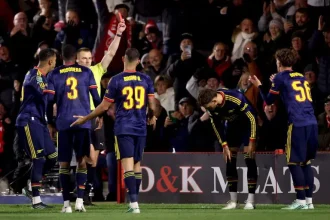
The sad final chapter: What happened to Raheem Sterling?
At 31 and currently without a club, Raheem Sterling is facing one of the most difficult periods of his career after admitting to dangerous driving following a Lamborghini crash involving nitrous oxide.
Once regarded as one of England’s most exciting attackers, Sterling enjoyed a remarkable spell at Manchester City, winning major trophies and becoming a regular for the national team. He also became an outspoken figure in football’s fight against racism.
However, his career has gradually moved in a different direction. After leaving Manchester City, Sterling struggled to find consistency at Chelsea, failed to establish himself during a loan spell at Arsenal and was eventually pushed out of Chelsea’s plans. A subsequent opportunity at Feyenoord failed to spark the revival many expected.
Now, with his club future uncertain, the latest legal trouble has added another difficult chapter to the story.
The court case
Sterling appeared at Basingstoke Magistrates’ Court on September 15, 2026, where he pleaded guilty to dangerous driving. The case followed an incident on May 28 involving a Lamborghini Urus on several roads, including the M25 and M3, before the vehicle crashed.
He also admitted possessing six nitrous oxide canisters for wrongful inhalation and failing to provide a specimen.
No other vehicle was involved and nobody was injured, although the crash caused significant damage to the Lamborghini.
Sterling was granted unconditional bail and temporarily disqualified from driving. A further hearing is scheduled for November 25, when the court will determine the next stage of sentencing.
From Liverpool wonderkid to Manchester City star
Sterling’s rise began at a young age. After developing in London and joining
Liverpool’s academy as a teenager, he quickly attracted attention because of his incredible pace, direct running and ability to take on defenders.
He made his Liverpool first-team debut at just 17 and soon became an important part of Brendan Rodgers’ team.
His performances eventually led to a £44 million move to Manchester City in 2015, potentially rising to £49 million. The transfer made him the most expensive English footballer at the time.
His best years at Manchester City
Sterling enjoyed the most successful period of his career at City, particularly after Pep Guardiola arrived.
He developed into a prolific attacking player, using his pace and intelligent movement to repeatedly find scoring positions.
Across 339 appearances for City, Sterling recorded 131 goals and 74 assists, while winning four Premier League titles, five League Cups and an FA Cup.
His 2018/19 campaign was particularly impressive, with 17 Premier League goals and 10 assists as City narrowly edged Liverpool to the title.
England success
Sterling also became a major figure for England, earning 82 caps between 2012 and 2022.
He played at three World Cups and two European Championships and was particularly influential at Euro 2020, scoring against Croatia, the Czech Republic and Germany as England reached the final.
Away from football, Sterling became one of the most prominent players speaking publicly about racism and unequal treatment in football and the media.
The Chelsea move changed everything
In 2022, Sterling left City for Chelsea in a £47.5 million deal.
On paper, the transfer appeared to offer him another opportunity to become a leading attacker. But Chelsea went through significant managerial and squad changes, making it difficult for Sterling to establish the same role he had enjoyed at City.
He scored 19 goals in 81 appearances for Chelsea, but his influence gradually declined as the club continued to reshape its squad.
Arsenal loan fails to revive his career
Sterling joined Arsenal on loan in 2024, hoping to rediscover his best form under Mikel Arteta.
Instead, his opportunities were limited. He made 17 Premier League appearances but started only seven times and failed to score a league goal.
Rather than becoming a key rotation option, Sterling increasingly found himself on the fringes.
A difficult final chapter
From being one of England’s biggest attacking stars to becoming a free agent at 31, Sterling’s career has taken an unexpected turn.
His achievements at Manchester City and with England remain significant, but his struggles at Chelsea, limited Arsenal spell and current legal situation have created a very different picture from the one many expected when he was emerging as Liverpool’s teenage sensation.
Available next action: �Create a downloadable DOCX file here in this chat containing the editable prose above